2026-09-14
Sticky Eye Discharge and Redness? Epidemic Keratoconjunctivitis (EKC) Isolation Period & When Kids Can Return to School
Epidemic keratoconjunctivitis (EKC) requires a 2-week isolation period from symptom onset. Learn why antibiotics fail, how to prevent home spread, and when kids can return to school.

If your child wakes up in the morning unable to open their eyes due to sticky discharge and has one severely bloodshot eye right around the start of the school semester, the most common culprit is Epidemic Keratoconjunctivitis (EKC).
To get straight to the point: there is no specific miracle cure for EKC, but most cases resolve on their own within 2 to 3 weeks.
Antibiotic eye drops will not cure it; the real challenge is not treatment, but contagion.
The American Academy of Ophthalmology considers the contagious period to be 10 to 14 days following the onset of symptoms, and school guidelines in Korea recommend a 2-week isolation period starting from the very first day symptoms appear.
Remember: this is a condition measured by the calendar, not simply by "the eye discharge stopped, so it must be fine."
Hello, this is St. Mary Jin Eye Clinic.
Today, we will break down the evidence-based facts on why EKC spreads so easily, when your child can safely return to school or daycare, and the complications to watch out for even after eye discharge resolves.
[Table of Contents]
Why does it peak specifically in August and September?
How does it differ from bacterial conjunctivitis?
Why does it spread so easily?
How long is isolation necessary? — Return-to-school criteria
How is it treated? — Why antibiotics don't work
What if vision remains blurry after discharge clears?
7 rules to prevent spreading it to family members
Frequently Asked Questions
1. Why does it peak specifically in August and September?
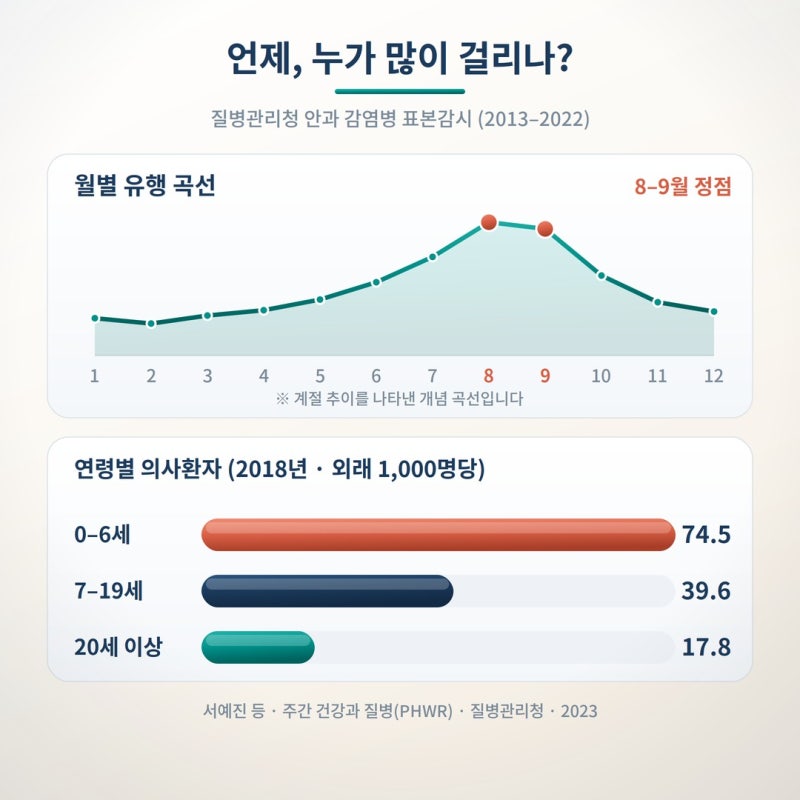
This isn't just a feeling; it is a clear pattern backed by statistical evidence.
According to a 10-year analysis of ophthalmic infectious disease sentinel surveillance data by the Korea Disease Control and Prevention Agency (KDCA), EKC displays distinct seasonality, peaking around August and September.
Infections originating from water activities and summer camps during school vacations coincide with the reopening of classrooms, allowing the virus to spread rapidly among students.
There are also significant differences across age groups.
Based on 2018 data, the year of the most severe outbreak, the number of suspected EKC cases per 1,000 outpatient visits to sentinel clinics was:
▶ Ages 0–6: 74.5 patients
▶ Ages 7–19: 39.6 patients
▶ Ages 20+: 17.8 patients
(Seo YJ et al., "Ophthalmic Infectious Disease Sentinel Surveillance Results, 2013–2022," Public Health Weekly Report (PHWR), KDCA, 2023)
In other words, preschoolers are affected more than four times as often as adults.
This explains why a single case in a daycare, kindergarten, or early elementary classroom can quickly sweep through the entire group.
2. How does it differ from bacterial conjunctivitis?
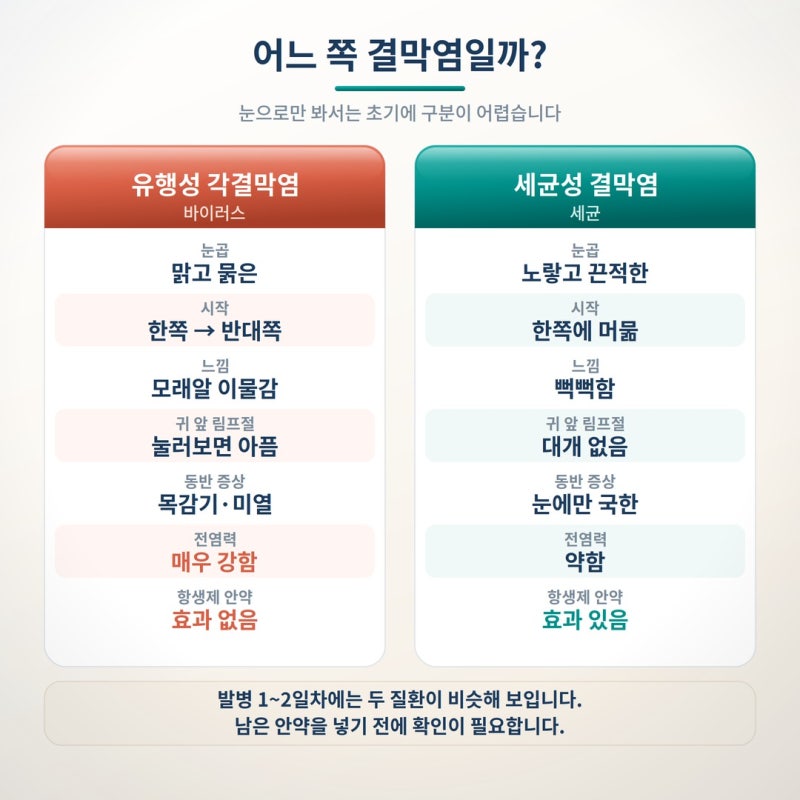
The treatments and isolation requirements for these two conditions are completely different.
Here is how clinicians distinguish between them in practice:
Category | Epidemic Keratoconjunctivitis (Viral) | Bacterial Conjunctivitis |
Discharge | Clear, watery secretion like tears | Thick, yellowish purulent mucus |
Onset | One eye → spreads to the other days later | Often remains confined to one eye |
Sensation | Gritty foreign-body sensation, light sensitivity | Dryness, eyelids sticking together |
Preauricular Lymph Nodes | Often tender when palpated | Usually absent |
Accompanying Symptoms | May accompany sore throat or mild fever | Usually limited to the eyes |
Contagiousness | Extremely high (isolation required) | Low |
Antibiotic Eye Drops | Ineffective | Effective |
To be completely candid, however, visual inspection alone cannot provide a 100% accurate differentiation in the earliest stages.
During days 1 and 2 of illness, both conditions can look remarkably similar, and they may even be confused with allergic conjunctivitis or a corneal abrasion.
This is why self-diagnosing based on discharge color and using leftover eye drops at home is a risky choice.
3. Why does it spread so easily?
The pathogen is adenovirus, with EKC primarily caused by types 8, 19, and 37
(Meyer-Rüsenberg B et al., Deutsches Ärzteblatt International, 2011).
There are two primary reasons this virus transmits so efficiently:
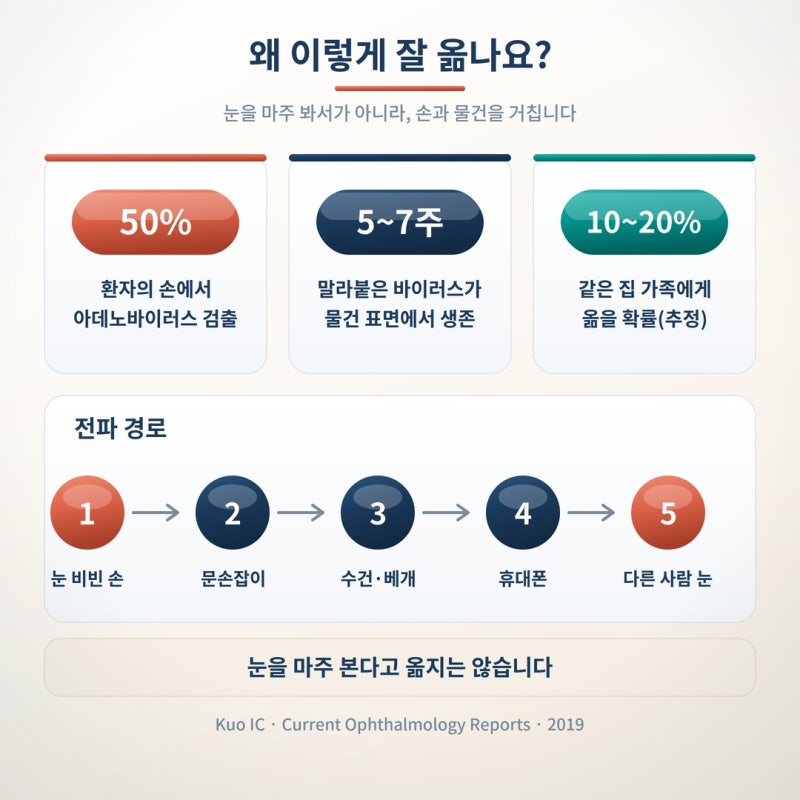
First, hands.
Adenovirus was cultured from the hands of approximately 50% of EKC patients visiting eye clinics.
Hands that rub an infected eye become direct vectors for transmission.
Second, exceptional survival on inanimate surfaces.
In a dried state, adenoviruses have been recovered viable from environmental surfaces up to 5 to 7 weeks later.
Towels, pillows, doorknobs, remote controls, smartphones, and sink faucets can all act as transmission routes.
(Kuo IC. Adenoviral Keratoconjunctivitis: Diagnosis, Management, and Prevention. Current Ophthalmology Reports, 2019)
Consequently, the risk of secondary transmission to family members sharing the same household is estimated at 10% to 20% (Kuo IC, 2019).
Contrary to a common myth, you cannot catch the virus simply by making eye contact.
Transmission always involves hands or contaminated objects. Understanding this is the cornerstone of prevention.
4. How long is isolation necessary? — Return-to-school criteria
Because this is the question parents ask most often, let's break it down clearly.
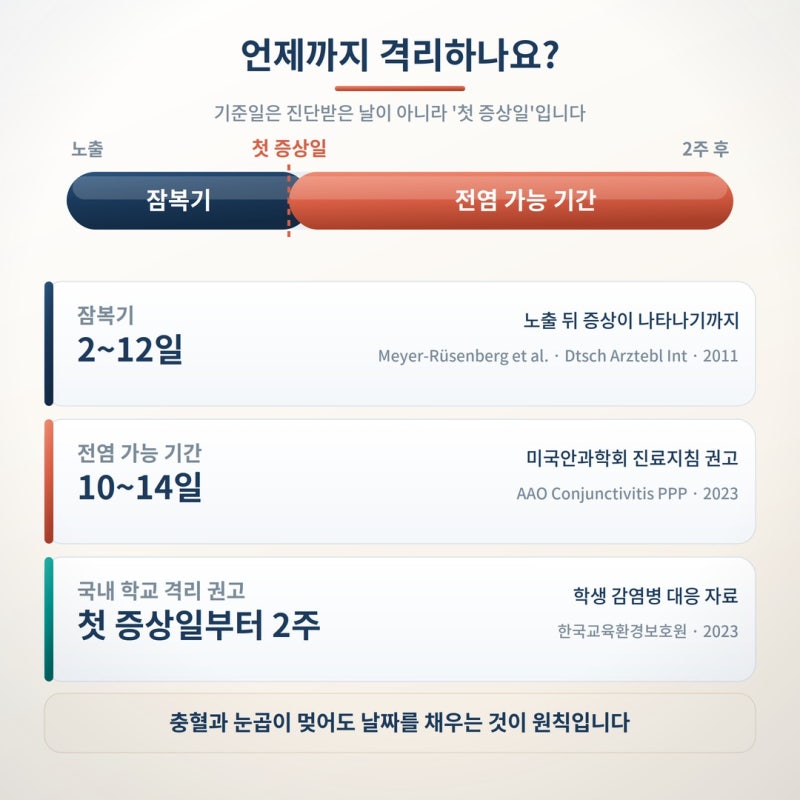
① The incubation period is 2 to 12 days
This is the time between viral exposure and the onset of clinical symptoms
(Meyer-Rüsenberg B et al., 2011).
If a classmate tests positive, your child should be closely monitored throughout this window.
② The contagious period lasts 10 to 14 days after symptom onset
The American Academy of Ophthalmology practice patterns recommend "frequent handwashing, using separate towels and pillows, and avoiding close personal contact during the contagious period, which typically lasts 10 to 14 days from presentation"
(American Academy of Ophthalmology, Conjunctivitis Preferred Practice Pattern, 2023).
Viral particles can be detected in tears for 2 to 3 weeks following initial infection
(Meyer-Rüsenberg B et al., 2011).
③ School guidelines in Korea recommend a 2-week isolation starting from initial symptoms
Educational infectious disease response guidelines from the Korea Institute for Educational Environment Protection state that for EKC, "isolation is recommended for 2 weeks from the onset of initial symptoms when contagiousness is highest"
(Korea Institute for Educational Environment Protection, Q&A on Student Infectious Disease Response, 2023).
In summary:
▶ The reference start date is the day symptoms first appeared, not the clinic visit date.
▶ Even if redness and eye discharge subside, completing the full quarantine timeframe is the medical standard.
▶ If you require a medical certificate for school or daycare, please request it during your consultation.
▶ The final decision to return to school is safest after an ophthalmologist confirms recovery on examination.
Let's address one major misconception here:
The belief that "I used eye drops, so I am no longer contagious" is false.
Because there is no medication that stops viral shedding, the contagious period runs its natural course regardless of whether eye drops are administered.
5. How is it treated? — Why antibiotics don't work
First, it must be clarified that there is currently no proven targeted antiviral medication that directly eliminates adenovirus.
The goals of treatment are symptom relief and complication prevention, rather than immediate viral eradication.
Why are antibiotic drops ineffective?
The American Academy of Ophthalmology clinical practice patterns explicitly state that "viral conjunctivitis does not respond to antibacterial agents"
(AAO Conjunctivitis PPP, 2023).
Antibiotics kill bacteria, whereas the underlying cause is a virus.
However, situations where an ophthalmologist prescribes them prophylactically—such as when severe corneal epithelial defects present a risk for secondary bacterial infection—are a deliberate clinical exception.
Standard clinical care includes:
Preservative-free artificial tears and cold compresses — Fundamental supportive care to alleviate foreign-body sensation and photophobia.
Corneal examination — Slit-lamp biomicroscopy to check for corneal erosions or opacities.
Pseudomembrane removal — If a white membranous exudate forms on the inner palpebral conjunctiva, it must be carefully peeled.
Topical corticosteroid drops — Used selectively and cautiously under ophthalmic supervision for corneal infiltrates or pseudomembranes.
Steroid drops must be used with extreme caution.
While they provide rapid symptomatic relief, medical literature notes that their overall benefit is limited and they may actually prolong the natural course of viral shedding
(Meyer-Rüsenberg B et al., 2011).
Furthermore, because of adverse risks such as elevated intraocular pressure, steroid-induced cataracts, and exacerbation of infection, you should never self-medicate or use leftover steroid drops. They must be used strictly following a physician's prescription for a limited duration.
6. What if vision remains blurry after discharge clears?
This touches on the "kerato" aspect of keratoconjunctivitis—involving the cornea. Because this complication often arises after initial conjunctival redness improves, many patients overlook it.
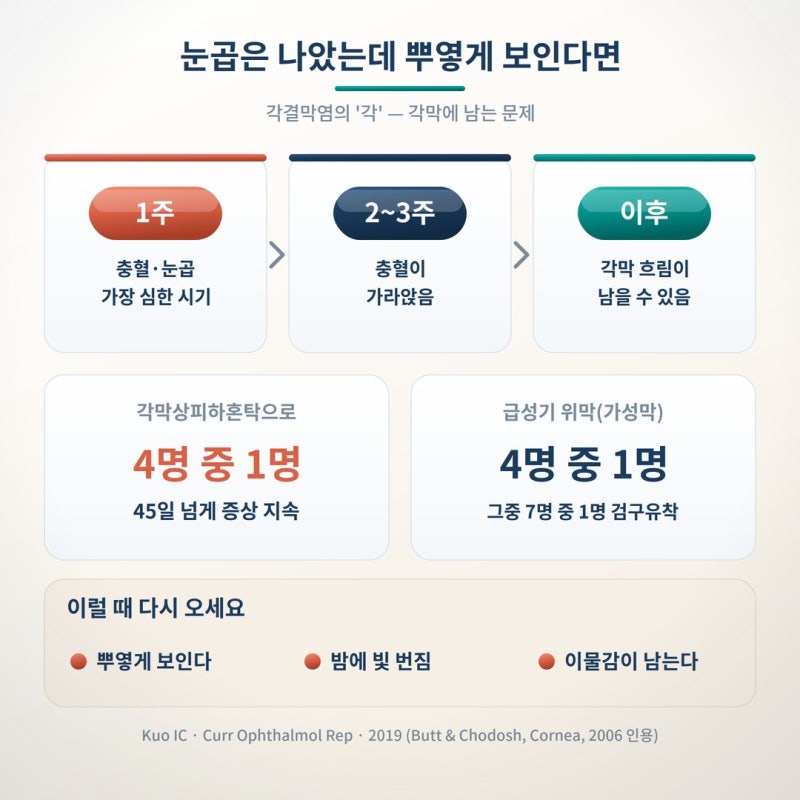
When inflammatory infiltrates reach the cornea, subtle subepithelial corneal infiltrates (SEIs) can persist. In a 6-year follow-up study of EKC patients at a tertiary eye clinic:
▶ Approximately 1 in 4 patients experienced persistent or recurrent symptoms lasting beyond 45 days due to subepithelial infiltrates.
▶ Approximately 1 in 4 patients developed pseudomembranes during the acute stage, and 1 in 7 of those developed symblepharon (adhesions between the palpebral and bulbar conjunctiva).
(Kuo IC, Current Ophthalmology Reports, 2019 — citing Butt & Chodosh, Cornea, 2006)
Therefore, you should return for a re-evaluation if you experience any of the following symptoms even after eye discharge and redness have resolved:
▶ Vision is blurry or appears as if looking through a fog.
▶ Significant glare or light halos around nighttime light sources.
▶ Lingering dryness and persistent gritty foreign-body sensation.
It is not uncommon to experience chronic stinging and dry eye disease after recovering from keratoconjunctivitis. When artificial tears alone fail to resolve symptoms, a dedicated assessment of the tear film and meibomian gland function is warranted.
7. 7 rules to prevent spreading it to family members
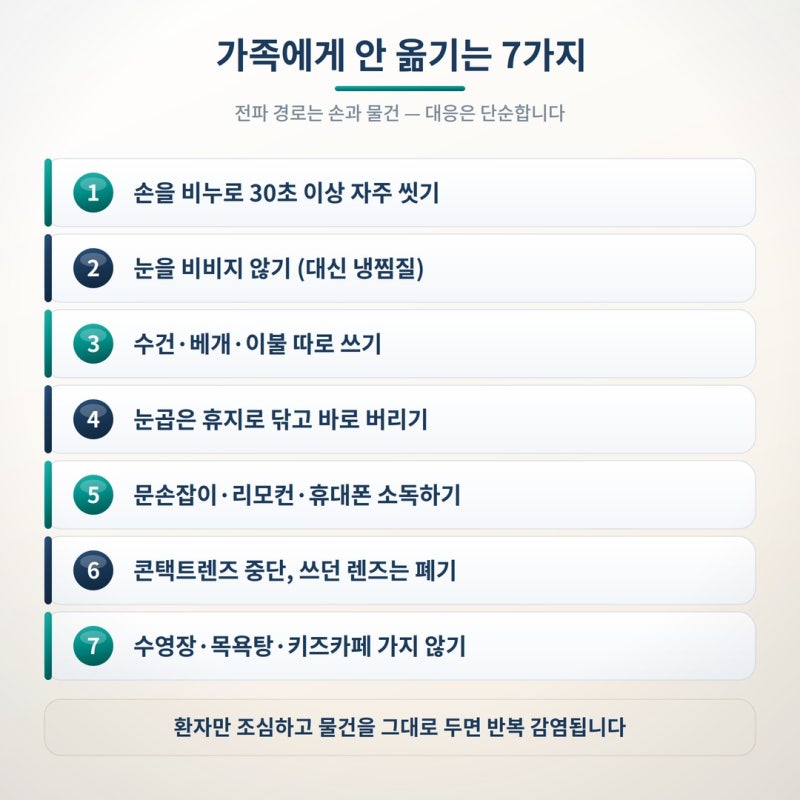
Managing this is straightforward once you remember that transmission occurs through hands and surfaces:
Wash hands frequently with soap for at least 30 seconds. Always wash hands immediately after touching the eye area.
Do not rub the eyes. If itching or foreign-body sensation is severe, apply cold compresses instead.
Use separate towels, pillowcases, and bedding. Boil towels daily or substitute with disposable paper towels.
Wipe away tears and discharge with disposable tissues and discard immediately. Avoid reusable cloth handkerchiefs.
Disinfect high-touch items such as doorknobs, remote controls, phones, faucets, and dining tables — the virus can survive on surfaces for 5 to 7 weeks.
Cease contact lens wear completely until full recovery is confirmed, and discard current lenses and cases.
Avoid public pools, saunas, and indoor playgrounds throughout the isolation period.
Rule #5 is particularly easy to overlook.
If the patient is careful but household surfaces remain unsterilized, secondary infections among family members will continue to cycle.
Here is an additional helpful resource regarding children's eye health:
8. Frequently Asked Questions
Q. How many days does it take for epidemic keratoconjunctivitis to heal?
It typically improves over 2 to 3 weeks following initial symptom onset.
Symptoms are usually most severe during days 3 to 5, followed by gradual resolution.
However, if subepithelial corneal infiltrates develop, haziness can persist for weeks or even months; thus, the cessation of discharge does not necessarily equal full recovery.
Q. If only one eye is infected, will it spread to the other?
It frequently does.
The opposite eye usually develops symptoms within a few days of the first eye, though the course in the second eye is often somewhat milder.
When administering eye drops, take care that the bottle tip or your fingertips do not touch the ocular surface, and instill drops into the unaffected eye before the infected eye.
Q. Can adults catch it?
Yes, absolutely. While statistics show higher incidence in children, adults are readily infected.
In adults, corneal complications can impair visual clarity and disrupt work life, and workplace outbreaks are common.
Masks offer little protection; rigorous hand hygiene remains paramount.
Q. Does wearing an eye patch reduce transmission?
It is not recommended for infection control.
Moisture accumulates under the patch, encouraging discharge buildup, and hands become contaminated when adjusting or touching the patch.
If photophobia is severe, wearing sunglasses or dimming ambient lighting is far safer and more effective.
Q. Are there vaccines or prophylactic medications?
There is currently no approved vaccine for epidemic keratoconjunctivitis.
Nor is there any preventive oral medication available after exposure.
Strict hand hygiene and segregating personal belongings remain the only definitive preventative measures.
Q. Can I get a medical certificate for school or workplace absence?
Yes, medical certificates can be issued following clinical examination.
Please mention this when checking in at reception so it can be prepared during your visit.
For more detailed insights on eye health, visit the St. Mary Jin Eye Clinic YouTube channel, 'Jjin Eye'.
Closing Thoughts
Most cases of epidemic keratoconjunctivitis resolve without long-term sequelae.
However, please remember these two critical rules:
First, isolation is counted by the calendar, not by subjective symptoms.
The standard guideline is 2 weeks from the first day symptoms appeared.
Second, if vision remains foggy or blurry after eye discharge has cleared, that is the crucial moment to examine the cornea.
If sudden eye redness and discharge appear, consult an eye specialist to identify the exact type of conjunctivitis before instilling leftover eye drops.
We will also clarify your isolation timeframe and safe return-to-school schedule during your consultation.
Please feel free to reach out with any questions.
St. Mary Jin Eye Clinic
337 Gangnam-daero, Seocho-gu, Seoul (Seocho-dong 1329-10)
5-minute walk from Gangnam Station Exit 5 · Free parking available on-site
Clinic Hours
Weekdays: 09:00 – 18:00 (Lunch: 13:00 – 14:00)
Saturdays: 09:00 – 15:00 (No lunch break)
Closed Sundays & Public Holidays
Tel: 02-577-7782
※ This article is intended for general medical informational purposes and does not substitute for individual diagnosis or treatment by a physician.
Appropriate medical interventions vary according to specific clinical findings; always consult an ophthalmologist for professional guidance.
Final determinations regarding isolation and school suspension follow the clinical judgment of the attending physician and school policies.
[References]
Seo YJ, Kim IH, Cha JO, Kang SK, Gwak J. Results of Ophthalmic Infectious Disease Sentinel Surveillance 2013–2022. Public Health Weekly Report (PHWR), Korea Disease Control and Prevention Agency (KDCA), 2023.
American Academy of Ophthalmology. Conjunctivitis Preferred Practice Pattern. 2023.
Meyer-Rüsenberg B, Loderstädt U, Richard G, Kaulfers PM, Gesser C. Epidemic Keratoconjunctivitis: The Current Situation and Recommendations for Prevention and Treatment. Deutsches Ärzteblatt International. 2011;108(27):475-80.
Kuo IC. Adenoviral Keratoconjunctivitis: Diagnosis, Management, and Prevention. Current Ophthalmology Reports. 2019.
Butt AL, Chodosh J. Adenoviral keratoconjunctivitis in a tertiary care eye clinic. Cornea. 2006.
Korea Institute for Educational Environment Protection. 2023 Student Infectious Disease Response Training Q&A: Infectious Diseases in Schools Explained by Experts. 2023.