2026-09-12
Still Dry Despite Using Artificial Tears? It Might Be an 'Oil' Deficiency, Not Water
If artificial tears fail to keep your eyes moist, meibomian gland dysfunction causing evaporative dry eye may be the cause. Learn about warm compresses, eyelid hygiene, and IPL therapy.
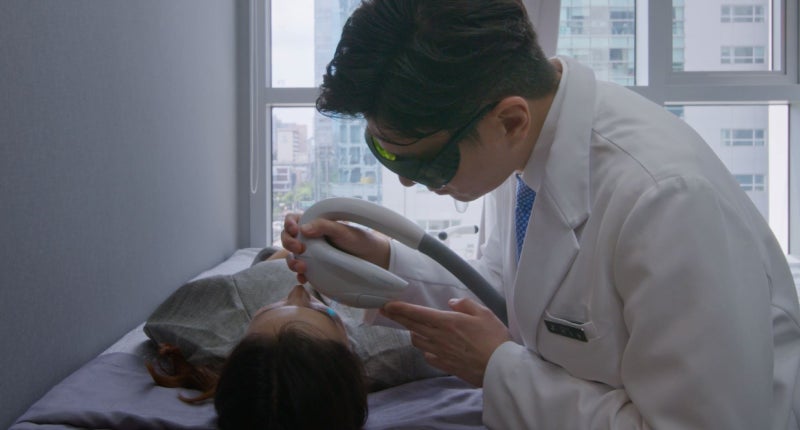

When your eyes feel dry, gritty, or stinging, artificial tears and lifestyle adjustments often provide relief.
It is generally not a dangerous condition on its own.
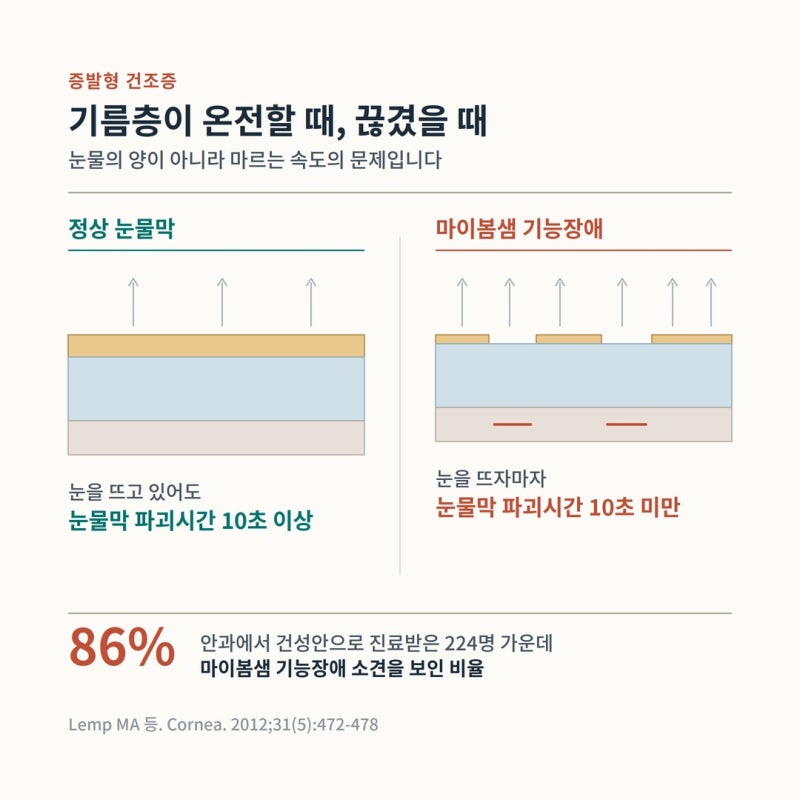
To get straight to the point: if you instill artificial tears several times a day yet your eyes feel dry again within 30 minutes, you should suspect the *evaporation rate* of your tears rather than the *quantity* of tears produced.
A thin lipid (oil) layer sits on the surface of your tears to prevent them from evaporating. This oil is secreted by the meibomian glands inside your eyelids.
When these glands become blocked, tears evaporate rapidly, no matter how often you replenish them.
In fact, a clinical study analyzing 224 patients diagnosed with dry eye syndrome revealed that 86% showed signs of Meibomian Gland Dysfunction (MGD) (Lemp MA et al., Cornea, 2012).
Hello, this is Catholic Jin Eye Clinic.
Today, we will discuss the true cause behind dry eyes that do not respond to artificial tears, what you should try first at home, and what you can realistically expect from treatments like IPL, all supported by scientific evidence.
[Table of Contents]
1. Why do my eyes remain gritty despite using artificial tears?
2. What are meibomian glands?
3. Which type of dry eye do I have?
4. Why does it worsen in autumn and during seasonal transitions?
5. Home Care ① Warm Compresses — What temperature and for how long?
6. Home Care ② Eyelid Cleansing and Conscious Full Blinking
7. How should I choose artificial tears?
8. Do omega-3 supplements actually help?
9. What does an ophthalmologist check during an exam?
10. When should IPL be considered? — And what remains uncertain?
11. It might not be simple dry eye disease
12. Frequently Asked Questions
1. Why do my eyes remain gritty despite using artificial tears?

The tear film is not merely a single layer of water; it consists of three distinct layers.
▶ ① Lipid (Oil) Layer — The outermost layer. It functions like a lid, preventing tears from evaporating. It is secreted by the meibomian glands in the eyelids.
▶ ② Aqueous (Water) Layer — The bulk of the tear volume. It is produced by the lacrimal glands.
▶ ③ Mucin Layer — The innermost layer. It anchors tears evenly across the surface of the cornea.
Most artificial tears on the market replenish the ② Aqueous Layer.
Therefore, if you apply artificial tears to an eye lacking an adequate ① Lipid Layer, your eyes will feel comfortable for a brief moment, but without a protective 'lid', the tears evaporate immediately. The common complaint—"It only feels good when I put them in, then it goes right back to being dry"—is actually an accurate clinical observation.
Broadly speaking, dry eye syndrome is divided into aqueous-deficient dry eye (not producing enough tears) and evaporative dry eye (tears are produced, but evaporate too fast).
In clinical practice, the evaporative type is far more common.
The aforementioned study of 224 patients found that 86% exhibited signs of meibomian gland dysfunction (Lemp MA et al., Cornea, 2012). Naturally, it is also common for both types to coexist.
2. What are meibomian glands?
Meibomian glands are tiny sebaceous glands lined up vertically inside both the upper and lower eyelids.
They open through minute orifices along the lid margins, just behind the eyelashes. Every time you blink, a small amount of oil is expressed from these openings to coat the surface of your tears.
The issue lies in the quality of this oil.
When meibomian gland dysfunction occurs, the secreted oil transforms from a clear liquid into a thick, paste-like consistency resembling toothpaste or hardened butter.
It stagnates within the narrow ducts, hardens further as it sits, and eventually plugs the openings.
If left untreated over a prolonged period, the glands may atrophy, becoming thin and foreshortened.
This leads to common symptoms such as:
▶ Waking up in the morning with gritty eyes that feel stuck together
▶ Red eyelid margins with oily residue or scurf around the lashes
▶ Recurrent styes (hordeola or chalazia)
▶ Paradoxical reflex tearing (eyes watering despite feeling dry)
▶ Vision blurring while reading screens, clearing temporarily after a blink
The last symptom is particularly telling.
When the tear film breaks up, the corneal surface becomes uneven, causing images to blur; blinking reapplies a smooth tear layer, momentarily restoring clarity.
If you find that your vision blurs but sharpens immediately upon blinking, the culprit is likely an unstable tear film rather than a refractive decline in your eyesight.
3. Which type of dry eye do I have?
While definitive diagnosis requires specialized testing, this checklist can guide your understanding before visiting a clinic.
Checklist | Likely Aqueous-Deficient | Suspect Evaporative (MGD) |
After applying eye drops | Relief lasts for a while | Becomes dry again quickly |
Upon waking in the morning | Generally comfortable | Eyelids feel stuck or heavy |
Eyelid margin appearance | Clean | Redness, oily crusts, or flakes |
Styes (Chalazia/Hordeola) | Rare | Recur frequently |
During screen work | Discomfort increases gradually | Vision blurs and fluctuates |
Tearing | Consistently parched feeling | Paradoxical tearing/watering |
Dry mouth/throat | May co-occur | Usually absent |
Contact lens wear | Uncomfortable right from insertion | Worsens rapidly by afternoon |
If you match two or more items in the right-hand column, evaluating your eyelids will likely resolve your issue faster than purchasing another bottle of artificial tears.
Take note of the "Dry mouth/throat" item.
If severe dry eyes are accompanied by dry mouth, difficulty swallowing dry foods without water, joint pains, or overwhelming fatigue, it is essential to screen for systemic autoimmune conditions such as Sjögren's syndrome.
In such cases, treating the eyes in isolation will not resolve the root cause, so be sure to mention these systemic symptoms during your consultation.
4. Why does it worsen in autumn and during seasonal transitions?
This occurs due to the simultaneous overlap of three key factors:
① Ambient humidity drops.
Drier air accelerates tear evaporation.
Add indoor heating or forced air to the mix, and direct drafts actively strip away your tear film.
Check if car vents blow directly onto your face or if office air vents blow down on your workstation.
② Indoor hours and digital screen exposure increase.
While focusing on screens, human blink frequency drops substantially.
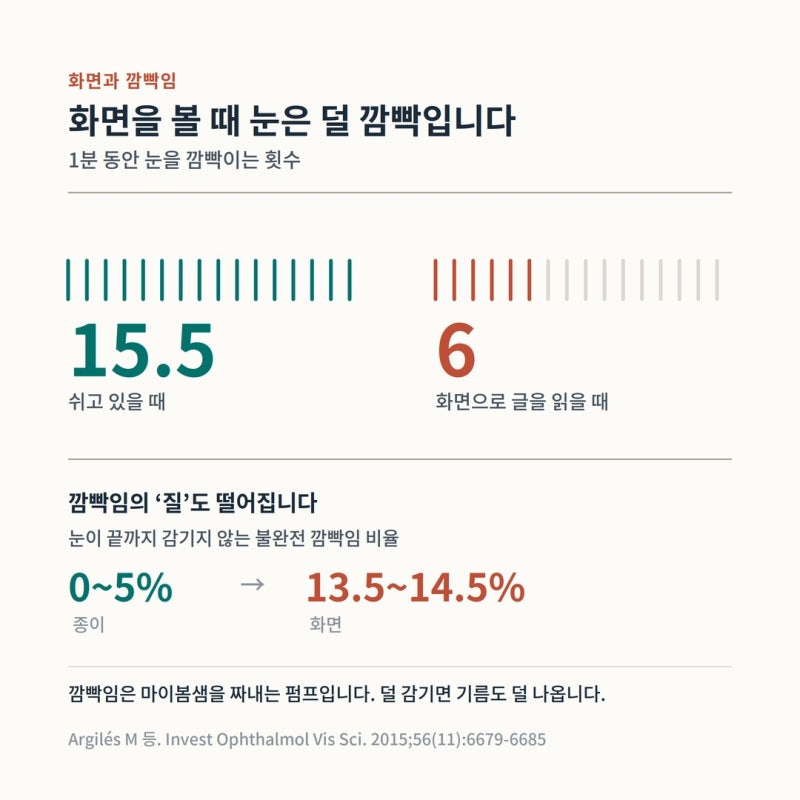
In an adult study, the spontaneous blink rate dropped from 15.5 blinks per minute at rest down to roughly 6 blinks per minute during on-screen reading
(Argilés M et al., Investigative Ophthalmology & Visual Science, 2015).
③ The quality of blinking deteriorates.
The same study found that incomplete blinks—where the eyelid fails to close fully—rose from 0–5% when reading hard copy to 13.5–14.5% while reading from a screen.
This third point is critical. Blinking acts as the physiological pump for the meibomian glands. Complete closure is necessary for the eyelid muscles to squeeze and express fresh oil. Partial blinks represent incomplete pumping. Prolonged screen work reduces oil delivery, fostering stagnation and causing the oil inside the glands to solidify further.
Note: Children's screen time is tied not only to ocular dryness but also to the progression of myopia, a topic covered extensively in our previous article.
5. Home Care ① Warm Compresses — What temperature and for how long?

The foundation of meibomian gland care is melting the hardened sebum.
However, simply telling patients to "put a warm washcloth on your eyes" rarely produces tangible results.
Optimal results require specific parameters for temperature and duration.
According to literature reviews:
▶ In patients with MGD, the meibomian lipids require an average temperature of 38.5°C (101.3°F) to melt into a liquid state
▶ Consequently, the target external eyelid surface temperature is 40–47°C (104–116.6°F)
▶ Temperatures exceeding 48–49°C pose a risk of thermal skin burns and offer no added therapeutic benefit
▶ The recommended session length is 5–15 minutes, performed 1 to 4 times daily
(Magno MS et al., Contact Lens and Anterior Eye, 2022)
The primary pitfall is the rate of heat loss.
In experiments cited in the same literature, a warm cotton towel starting at 39.2°C dropped below 35°C within 2 minutes and fell below 30°C after 12 minutes.
This means that if you soak a washcloth once and leave it on your eyes for 10 minutes, the effective therapeutic window was likely restricted to the initial 1 to 2 minutes.
Here is how to do it correctly:
If using wet towels, reheat them every 2 minutes. Keeping a bowl of hot water nearby to alternate between two cloths is a practical method.
A microwavable heated eye mask or an electric heat device designed to maintain constant temperature is far more effective than a wet towel.
Avoid pressing down hard on your eyes. The objective is thermal transfer, not mechanical pressure.
Immediately after the warm compress, gently massage your eyelid margins toward the lashes (downward on the upper lid, upward on the lower lid) to encourage molten oil expression.
Do not expect immediate changes after one or two sessions. Daily consistency for at least 4 to 8 weeks is necessary before assessing clinical outcomes.
To be completely candid:
While warm compresses are safe and inexpensive, they demand meticulous compliance and are prone to patient abandonment.
They fail not because the mechanism is flawed, but because regular execution is difficult to maintain.
6. Home Care ② Eyelid Cleansing and Conscious Full Blinking
Eyelid Cleansing: When crust, debris, and desquamated cells accumulate along the base of the eyelashes, they occlude the meibomian gland orifices.
Following a warm compress, use lukewarm water or dedicated eyelid hygiene wipes/cleansers on a cotton swab or gauze pad to gently wipe along the lash line. Avoid using regular facial foams or shampoo directly on your eyelids, as getting these inside the eye disrupts the ocular surface and tear film.
Conscious Complete Blinking: During intense screen use, pause once every hour and perform the following sequence 10 times:
1. Close your eyes gently.
2. Hold them closed for 2 seconds (this 2-second hold is vital).
3. Squeeze the eyelids firmly shut for 1 second.
4. Open your eyes normally.
Complement this routine with the 20-20-20 rule (looking at an object 20 feet away for 20 seconds every 20 minutes), positioning screens slightly below eye level to minimize the exposed ocular surface area, maintaining indoor humidity, and redirecting airflow away from your face.
These environmental and behavioral adjustments may feel tedious, but without them, other medical interventions will yield only temporary benefits.
7. How should I choose artificial tears?
This is not an advisory against artificial tears.
They remain the frontline palliative therapy to alleviate discomfort and can be used continuously. Keep two key principles in mind:
① If instilling drops more than 4 to 6 times daily, verify the preservative status.
Many multi-dose dropper bottles contain benzalkonium chloride (BAK) as a preservative.
Used in roughly 70% of ophthalmic formulations, BAK exhibits cytotoxic effects on corneal and conjunctival epithelial cells at concentrations as low as 0.005%, with surface abnormalities reported after as little as 7 days of exposure
(Goldstein MH et al., Eye, 2022). The more frequently you administer drops, the safer it is to choose single-use, preservative-free formulations.
② Lipid-containing formulations are available.
If you suffer from evaporative dry eye, an artificial tear containing a lipid (oil) emulsion may provide superior comfort over standard aqueous-only saline drops.
However, lipid formulas can feel viscous or induce transient visual blurring, so personal tolerance varies.
③ Protection precedes replenishment.
Adding artificial tears to an evaporative eye is like continually pouring water into a leaky basin. Unless the basin's integrity (the lipid barrier) is restored, water must be added perpetually.
8. Do omega-3 supplements actually help?
This is one of the questions we encounter most frequently.
Looking strictly at clinical trial evidence, the results are less dramatic than popular belief suggests.
In the large-scale DREAM trial in the United States, 535 dry eye patients were randomized to receive either 3,000 mg of omega-3 daily (2,000 mg EPA + 1,000 mg DHA) or an olive oil placebo for 12 months. Symptom scores improved by 13.9 points in the omega-3 group and by 12.5 points in the placebo group, demonstrating no statistically significant difference between the two cohorts
(Asbell PA et al., DREAM Study Research Group, New England Journal of Medicine, 2018).
Subsequent extension studies confirmed consistent findings.
This does not mean you should immediately discontinue omega-3 supplements.
Omega-3 fatty acids offer systemic health benefits, and individual patients do occasionally report subjective ocular improvement.
However, relying solely on an oral supplement while neglecting physical eyelid care, warm compresses, and ergonomic modifications often leads to treatment failure.
9. What does an ophthalmologist check during an exam?
A brief consultation that concludes simply with "your eyes are dry" is insufficient. Accurate treatment requires categorizing the subtype of dry eye and assessing lid morphology.
① Detailed Medical History — We determine when symptoms peak, how long artificial tears provide relief, current medications (antihistamines, certain antihypertensives, antidepressants, and isotretinoin can exacerbate dryness), contact lens wear, ocular surgery history, and coexisting joint or systemic dryness symptoms.
② Slit-Lamp Biomicroscopy — The most vital examination. The doctor directly assesses whether the meibomian orifices are occluded, whether the expressed meibum is clear or thick like toothpaste, and whether collarettes or keratinization exist at the lash bases.
③ Tear Film Break-Up Time (TBUT) — Measures how many seconds the tear film remains intact following a blink. A TBUT under 10 seconds indicates tear film instability.
④ Schirmer's Test — Measures baseline tear volume to differentiate aqueous-deficient dry eye.
⑤ Ocular Surface Staining — Evaluates the extent of corneal and conjunctival epithelial damage via fluorescein dye. Discrepancies between subjective symptoms and objective tissue damage are frequent; staining provides balanced staging.
⑥ Adjunctive Diagnostic Tests — Checking for concomitant blepharitis, Demodex infestation, ocular allergies, nasolacrimal duct obstruction, or conjunctivochalasis (loose conjunctival folds displacing the tear meniscus).
Dry eye disease is not a condition diagnosed once and forgotten; it is a chronic condition that must be systematically tracked and managed. Establishing objective baseline markers during your initial visit is critical.
10. When should IPL be considered? — And what remains uncertain?

Intense Pulsed Light (IPL), originally developed in dermatology for facial erythema and vascular anomalies, has been adapted for periocular application.
By delivering controlled pulses of broad-spectrum light to the periocular skin, it aims to:
① Elevate eyelid tissue temperature to liquefy obstructed meibum
② Thrombose abnormal telangiectatic vessels that supply inflammatory mediators to the eyelid margins
Following an IPL session, mechanical meibomian gland expression is usually performed. The standard clinical protocol typically involves 4 sessions spaced 2 to 4 weeks apart.
What the Evidence Confirms
In a systematic review and meta-analysis of 13 randomized trials involving 875 patients, IPL achieved a 16-point reduction in Ocular Surface Disease Index (OSDI) symptom scores compared to untreated control groups (95% CI: 12–20 points). The investigators rated the certainty of this evidence as 'moderate'
(Peira N et al., Acta Ophthalmologica, 2024).
Objective clinical parameters demonstrate measurable improvement as well.
In a multi-center randomized controlled trial across three US sites evaluating 82 patients with moderate-to-severe MGD, 4 sessions at 2-week intervals yielded a 2.0-second increase in tear film break-up time (vs 0.75 seconds in sham controls, P<0.01) and an 18.5-point improvement in meibomian gland score (vs 5.2 points in sham controls, P<0.0001)
(Toyos R et al., PLOS ONE, 2022).
What Remains Uncertain — Factors to Weigh Carefully
Additive benefit over conventional care is modest and less certain. In the same systematic review, adding IPL on top of standard medical therapy yielded an incremental symptom score improvement of 7 points (95% CI: 3–12 points), with the evidence certainty graded as 'very low.' In real-world clinical practice, IPL supplements rather than replaces warm compresses and lubricants, making this incremental metric especially relevant.
Symptom improvement is not always uniquely attributable to light pulses. In the 82-patient study above, despite clear objective improvements, subjective symptom scores improved by identical margins (25.9 points) in both the IPL and sham groups (P=0.9984). This underlines the substantial therapeutic contribution of mechanical gland expression, structured compliance, and placebo effects.
Results are not permanent. MGD is a chronic, recurring condition. Without persistent home maintenance (warm compresses and lid hygiene), gland obstruction tends to recur. Periodic maintenance sessions may be required.
Regeneration of atrophied glands is unproven. While isolated retrospective reports suggest subtle structural restoration of gland architecture after thermal pulsation, the changes are minimal and limited by study design. Currently, IPL should be understood as a means to preserve and optimize surviving gland tissue, not to regenerate lost glands.
Adverse Effects: Reported adverse events are generally mild, including transient erythema, mild discomfort, burning sensation, and swelling, with an absence of serious vision-threatening events. However, safety evidence certainty was also graded as 'very low.' Rare risks include blistering, dyspigmentation, madarosis (loss of lashes), or inadvertent ocular injury if protective eye shields are improperly placed.
Contraindications and Precautions
▶ Deep skin tones (Fitzpatrick types V–VI) face heightened risks of epidermal hyper/hypopigmentation or superficial thermal injury; IPL is generally avoided or applied with extreme caution
▶ Concurrent use of photosensitizing medications (e.g., isotretinoin, tetracyclines)
▶ Pregnancy and lactation
▶ Active periocular skin infections, active dermatoses, or recent significant sun exposure/tanning
▶ Tattoos or permanent makeup in the periocular field; autoimmune conditions with photosensitivity
▶ Strict post-procedure UV protection is required for at least 4 weeks
In summary: IPL is an advanced, secondary option for patients with verified meibomian gland dysfunction who continue to experience significant symptoms despite diligent warm compresses, lid hygiene, and optimized lubricants.
It is not a primary first step. Our clinic is equipped with the Lumenis M22 system, and we recommend therapy only after confirming objective meibomian architecture via diagnostic imaging.
11. It might not be simple dry eye disease
This may be the most crucial section of this article.
A complaint of "grittiness" or "ocular fatigue" often conceals disorders distinct from standard dry eye.
▶ Allergic Conjunctivitis — Itching typically outweighs dryness. Patients rub their eyes, and the conjunctiva can exhibit chemosis (swelling). Strong seasonal variability is common.
▶ Blepharitis — Intimately related to MGD. Features red, irritated lid margins and scurfy lash deposits. Demodex mite infestations may play a role, necessitating specialized acaricidal lid therapies.
▶ Post-Viral Keratoconjunctivitis Dryness — Protracted surface instability following severe epidemic keratoconjunctivitis due to persistent subepithelial corneal infiltrates and goblet cell disruption.
▶ Conjunctivochalasis — Redundant, loose conjunctival tissue folds that mechanical displace the inferior tear meniscus, giving a sensation of friction despite normal tear production. Common in elderly patients.
▶ Drug-Induced Dryness — Systemic antihistamines, select diuretics, beta-blockers, tricyclic antidepressants, oral retinoids, or preservatives within chronic glaucoma drops can directly cause ocular dryness.
▶ Systemic Autoimmune Conditions — Sjögren's syndrome, thyroid eye disease, and rheumatoid arthritis.
▶ Post-Refractive Surgery Dryness — Neurotrophic corneal hypoesthesia during nerve regeneration after LASIK or PRK can cause dry eye signs for several months.
Crucially: If you experience significant ocular pain, visual deterioration, marked photophobia, persistent thick purulent discharge, or strictly unilateral acute symptoms, do not assume it is dry eye. Seek prompt in-person ophthalmic evaluation.
12. Frequently Asked Questions
Q. Will using artificial tears frequently stop my eyes from producing their own tears?
No. There is no biological mechanism or clinical evidence suggesting that artificial tears create physiological dependence or decrease endogenous tear secretion. However, if you apply drops more than 4 to 6 times daily, preservatives can irritate the ocular surface. Switch to single-use, preservative-free eye drops
(Goldstein MH et al., Eye, 2022).
Q. Should I start with warm compresses or artificial tears?
Use both, as they address distinct aspects of the condition. Artificial tears offer rapid symptomatic relief; warm compresses and lid hygiene target the underlying obstructive etiology. Relying solely on artificial tears temporarily eases discomfort while leaving meibomian blockage untreated.
Q. How many IPL sessions are necessary, and how long do the benefits last?
Standard clinical protocols involve 4 treatment sessions administered every 2 to 4 weeks. Because MGD is an ongoing chronic state, the procedure does not offer a permanent cure. Patients must continue foundational home compress and cleansing routines to maintain gland patency. Depending on the individual, maintenance sessions may be beneficial every 6 to 12 months.
Q. Am I a suitable candidate for IPL?
Patients with darker skin tones, those on photosensitizing drugs (isotretinoin, tetracyclines), pregnant or nursing women, individuals with active skin lesions or tattoos in the treatment field, or those with recent tanning/intense sun exposure are either unsuitable or require heightened caution. Your physician will review your medications and dermal health before scheduling treatment.
Q. Is post-LASIK/PRK dry eye treated the same way?
Foundational surface care is similar, but the underlying mechanism differs. Post-refractive dryness relates primarily to corneal sensory nerve transection and gradual re-innervation, which typically improves with time. However, if subclinical MGD was present prior to surgery, postoperative discomfort can be amplified and prolonged. Preoperative eyelid assessment and management are highly advantageous.
Q. Can dry eye syndrome be cured completely?
In most instances, dry eye is a manageable chronic condition rather than an acutely curable disease. Much like managing blood pressure or blood sugar, the goal is sustained stabilization and symptom suppression. While this reality can feel discouraging, patients who approach care with this mindset achieve far better long-term comfort. Searching for a single "instant fix" usually results in fragmented, unsuccessful treatment cycles.
Q. What is the optimal indoor humidity level?
Maintaining ambient indoor humidity between 40% and 60% is standard clinical advice. However, ambient moisture alone is not a cure-all. Preventing HVAC vents, fans, or heating blowers from directing air toward your face often provides greater subjective relief than merely adjusting humidity numbers.
For further in-depth ophthalmic educational discussions, visit the Catholic Jin Eye Clinic YouTube channel, 'Jineye'.
Closing Thoughts
Dry eye syndrome is common, largely benign, and manageable with the right interventions.
Remember these three fundamentals:
First, if artificial tears provide only ephemeral relief, investigate the lipid barrier rather than simply increasing tear volume.
Second, warm compresses must reach 40–47°C, be sustained (reheated every 2 minutes if using towels), and be maintained daily for 4 to 8 weeks to allow proper clinical assessment.
Third, procedures like IPL represent secondary options to explore after foundational eyelid hygiene and thermal therapy have been thoroughly implemented—not a primary shortcut.
Before buying yet another brand of eye drops, schedule an eyelid evaluation with an eye care professional.
Hearing "your meibomian glands are healthy and open" is in itself valuable guidance for directing your future eye care.
Please feel free to reach out if you have any questions.
Catholic Jin Eye Clinic
337 Gangnam-daero, Seocho-gu, Seoul (Seocho-dong 1329-10)
5-minute walk from Gangnam Station Exit 5 · Free parking in building
Clinic Hours
Weekdays: 09:00 – 18:00 (Lunch: 13:00 – 14:00)
Saturdays: 09:00 – 15:00 (No lunch break)
Closed Sundays & Public Holidays
Phone: 02-577-7782
※ This article is intended for general educational purposes only and does not replace individualized medical diagnosis or treatment by a physician. Numerical values cited represent group averages from referenced clinical trials; individual clinical outcomes vary depending on ocular status, medications, and environmental factors. Every medical intervention entails limitations and potential risks. Decisions regarding procedural interventions should be made following comprehensive diagnostic evaluation and consultation with an ophthalmologist.
[References]
Lemp MA, Crews LA, Bron AJ, Foulks GN, Sullivan BD. Distribution of aqueous-deficient and evaporative dry eye in a clinic-based patient cohort: a retrospective study. Cornea. 2012;31(5):472-478
Argilés M, Cardona G, Pérez-Cabré E, Rodríguez M. Blink rate and incomplete blinks in six different controlled hard-copy and electronic reading conditions. Investigative Ophthalmology & Visual Science. 2015;56(11):6679-6685
Magno MS, Olafsson J, Beining M, et al. Hot towels: The bedrock of Meibomian gland dysfunction treatment — A review. Contact Lens and Anterior Eye. 2022;101775
Goldstein MH, Silva FQ, Blender N, Tran T, Vantipalli S. Ocular benzalkonium chloride exposure: problems and solutions. Eye. 2022;36:361-368
Asbell PA et al., Dry Eye Assessment and Management (DREAM) Study Research Group. n−3 Fatty Acid Supplementation for the Treatment of Dry Eye Disease. New England Journal of Medicine. 2018
Peira N, Ali EM, Modén NK, et al. Effectiveness and safety of intense pulsed light therapy for dry eye symptoms due to meibomian gland dysfunction — A systematic review and meta-analysis. Acta Ophthalmologica. 2024;103(4):371-379
Toyos R, Desai NR, Toyos M, Dell SJ. Intense pulsed light improves signs and symptoms of dry eye disease due to meibomian gland dysfunction: A randomized controlled study. PLOS ONE. 2022;17(6):e0270268
Jones L, Downie LE, Korb D, et al. TFOS DEWS II Management and Therapy Report. The Ocular Surface. 2017;15(3):575-628