2026-09-15
My Eyelid Keeps Twitching — It's Not a Magnesium Deficiency. Here Is When You Actually Need to See a Doctor
Eyelid twitching is rarely caused by magnesium deficiency, but rather by fatigue, stress, and eye strain. Learn when it resolves on its own and when to see an eye doctor.


Let's start with the conclusion right away.
Occasional, brief twitching in the lower eyelid usually resolves on its own.
Medically referred to as benign eyelid myokymia, it is a phenomenon where tiny bundles of muscle fibers in the orbicularis oculi muscle spontaneously contract in fine, rippling waves.
Episodes often come and go over seconds to hours, and in most cases, they disappear completely within days to a few weeks
(Sarkar P et al., StatPearls, 2023 / American Academy of Ophthalmology, EyeWiki).
Now, let's address the most widespread myth first.
There is no evidence that magnesium deficiency is the cause.
A well-conducted study in South Korea directly examined this.
When comparing the blood profiles of 72 patients experiencing eyelid twitching with a control group of 197 people, there was no statistically significant difference between the two groups in serum levels of magnesium, calcium, or phosphorus.
What actually showed a difference were fatigue levels and sleep quality
(Kim J, Hyung SW, Han SK, Lee JY, Yu HJ, Sunwoo MK, Korean Journal of Health Promotion, 2021;21(4):129-133).
However, there is an essential takeaway in this article that you must not overlook.
Mixed among typical eyelid twitches are two distinct medical conditions that do not heal on their own and can significantly impair daily life if left untreated.
Distinguishing them is not complicated.
Is it on one side or both sides? Does it stay in the eyelid, or does it spread across the face? Looking at just these two factors will classify most cases.
Hello, this is St. Mary's Jin Eye Clinic.
Today, we will review the medical evidence explaining why eyelid twitching happens, how long you can safely wait, and which warning signs point to a different underlying condition.
[Table of Contents]
Eyelid twitching: What is actually happening in the eye?
Isn't it caused by a lack of magnesium?
Then what is the real cause?
How long can it last before you need to see a doctor?
Distinguishing three conditions is key
What is 'blepharospasm', where the eyes clamp shut?
What about 'hemifacial spasm', where one side of the face twitches?
Can dry eyes cause twitching?
What to do at home vs. what does not work
What happens during an eye clinic examination?
How is it treated? Are there side effects?
Is frequent blinking in children the same thing?
When to seek medical attention immediately
Frequently Asked Questions
1. Eyelid twitching: What is actually happening in the eye?
Surrounding the eye is a doughnut-shaped muscle known as the orbicularis oculi.
It is the muscle responsible for closing and blinking the eyes.
This muscle is broadly divided into two portions.
The palpebral part, which lies thinly within the eyelids, and the orbital part, which broadly encircles the outside.
In benign eyelid myokymia, the entire muscle does not contract.
Instead, only tiny fascicles among the countless muscle fibers contract independently in fine, irregular ripples.
As a result, the eye does not forcefully close; instead, only the eyelid skin appears to flutter slightly.
It has three key characteristics.
It usually occurs in one eye, most commonly in the lower eyelid.
While the person experiencing it feels it intensely, people nearby rarely notice it. This is because the actual amplitude of movement is extremely small. That is why many patients say, "It's twitching like crazy, but nobody else can see it."
It does not clamp the eye shut or block vision. If the twitching is closing your eye so you cannot see, it is a different condition.
If looking in the mirror reveals only a faint, gentle fluttering of the eyelid skin, it falls into this category.
2. Isn't it caused by a lack of magnesium?
This is the question we hear most often in the consultation room.
However, scientific evidence paints a very different picture.
The Korean study mentioned earlier tackled this question head-on.
The paper's title was literally: "Will Hypomagnesemia Induce Benign Eyelid Myokymia?"
After comparing blood magnesium, calcium, and phosphorus levels between 72 patients with eyelid twitching and 197 controls, none of the three minerals showed a significant difference between the groups.
The researchers concluded: "Eyelid twitching is not associated with serum magnesium levels"
(Kim J et al., Korean Journal of Health Promotion, 2021).
International literature shares the same conclusion.
Clinical reviews on eyelid myokymia explicitly state that there is no objective evidence supporting popular remedies such as tonic water, calcium, folic acid, potassium, or multivitamins
(Sarkar P et al., StatPearls, 2023).
Why, then, do so many people report that taking magnesium cured their twitch?
Because this symptom naturally resolves on its own within days to weeks even if left completely untreated.
Whatever you happen to be doing at that point, the condition naturally improves during that window. This creates the illusion that whatever supplement was taken was the cure.
To avoid misunderstanding:
This does not mean magnesium supplements are harmful.
If someone is genuinely deficient in magnesium (hypomagnesemia), supplementation is necessary. However, true deficiency presents with systemic symptoms like numbness in the hands and feet, widespread muscle cramps, and cardiac arrhythmias—not just an isolated eyelid twitch.
Twitching confined solely to the eyelid does not imply a magnesium deficiency, and taking supplements does not treat the underlying symptom.
If you suspect an actual magnesium deficiency, the accurate approach is to get a blood test at an internal medicine clinic, not an eye exam.
3. Then what is the real cause?
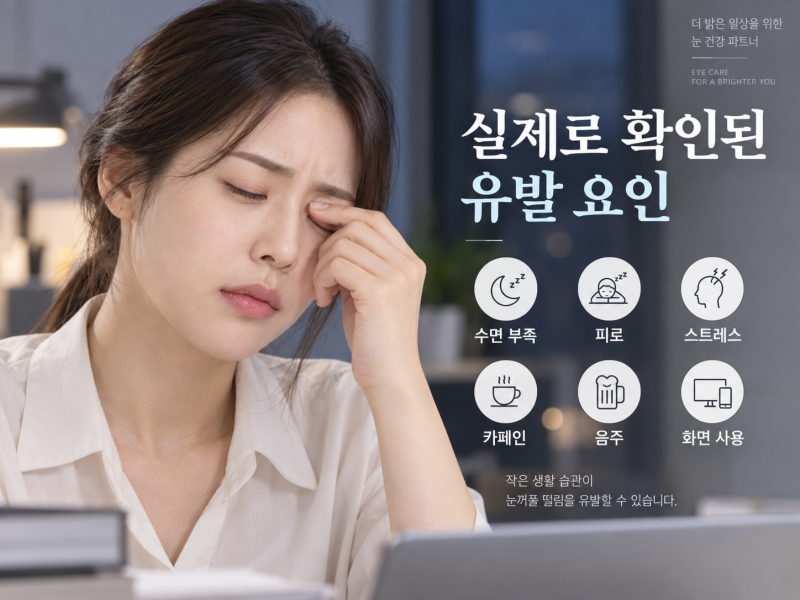
Triggers repeatedly identified in clinical literature include
(American Academy of Ophthalmology, EyeWiki / Sarkar P et al., StatPearls, 2023):
Lack of sleep
Fatigue — especially cumulative exhaustion
Stress and anxiety
Excessive caffeine intake
Alcohol consumption
Prolonged screen time
Certain medications — topiramate, clozapine, flunarizine, etc. (relatively uncommon)
In the Korean study cited earlier, the only variables that actually showed a significant correlation were fatigue levels and poor sleep quality.
Reviewing this list reveals a clear pattern.
Most can be summed up with: "Have you been overworking your body lately?"
Weeks filled with overtime, exam periods, sleepless nights caring for a sick child, or major transitions like moving or changing jobs commonly trigger these twitches.
Therefore, eyelid twitching is less an ocular disease and more of an alert signal sent by your body.
It simply manifests around the eye.
The orbicularis oculi is one of the thinnest, most delicate muscles in the human body, so it reacts first to systemic physical stress.
4. How long can it last before you need to see a doctor?

Duration | What It Usually Means | Recommended Action |
Within a few days | Most common scenario | Adjust sleep, caffeine, and screen habits |
1 to 2 weeks | Still within typical range | Continue lifestyle modifications and monitor |
Over 3 weeks | Needs evaluation | Visit an eye clinic |
Regardless of duration | If red flags appear | Seek immediate eye consultation |
Here are the warning signs requiring immediate medical attention regardless of duration:
▶ The twitching spreads beyond the eyelid to the cheek, corner of the mouth, or jaw
▶ Both eyes involuntarily clamp shut, making them difficult to open
▶ An eyelid droops, or you experience double vision
▶ Family members notice the twitching persists even while you are asleep
▶ You experience numbness or weakness on one side of the face
These five symptoms are not typical of benign eyelid myokymia.
They necessitate ruling out the two other conditions described below.
Conversely, here is something to reassure you:
Eyelid twitching is almost never an early sign of a stroke or impending vision loss.
In fact, when neuroimaging is performed for chronic isolated eyelid twitching, abnormal findings are exceptionally rare, meaning routine brain scans are not recommended
(Sarkar P et al., StatPearls, 2023).
Brain imaging is reserved selectively for when the red flags listed above are present.
5. Distinguishing three conditions is key
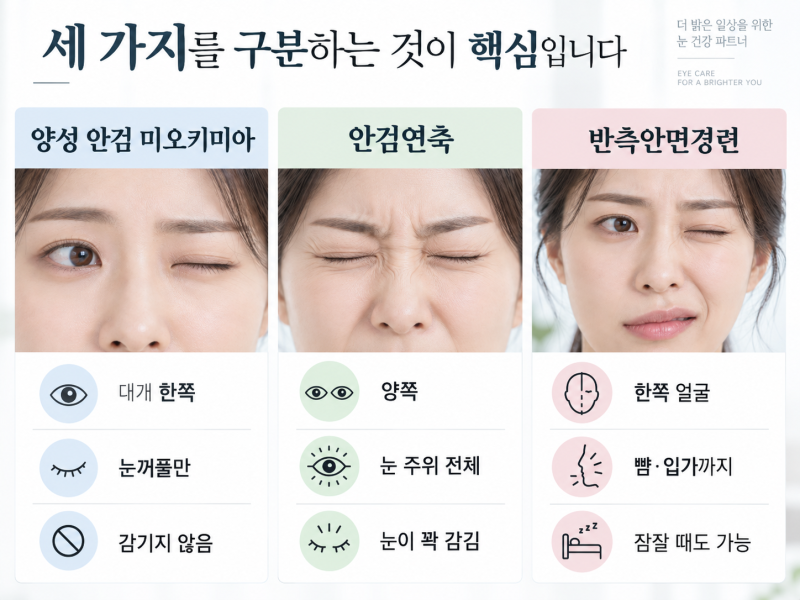
This is the most critical comparison to keep in mind:
| Benign Eyelid Myokymia | Blepharospasm | Hemifacial Spasm |
Location | Usually unilateral | Bilateral (both eyes) | Unilateral face |
Extent | Eyelid skin only | Entire periocular area | Eye → Cheek → Mouth |
Eye closure | Does not close | Clamps tightly shut | Eye closes while mouth corner pulls up |
During sleep | Stops | Stops | May continue |
Course | Resolves spontaneously | Does not resolve spontaneously | Does not resolve spontaneously |
(American Academy of Ophthalmology, EyeWiki: Eyelid Myokymia / Blepharospasm / Hemifacial Spasm)
When reviewing the table, check the first row first:
▶ One side only, stays within the eyelid → Likely benign myokymia
▶ Both eyes, clamping shut involuntarily → Suspicious for blepharospasm
▶ One side, spreading down to cheek and mouth → Suspicious for hemifacial spasm
Next, observe what happens during sleep. Myokymia and blepharospasm subside during sleep.
In contrast, hemifacial spasm can persist while asleep, providing a vital clinical clue for differentiation
(AAO EyeWiki, Hemifacial Spasm).
Asking a family member or partner, "Does my face twitch even when I am sleeping?" can provide valuable clarity.
6. What is 'blepharospasm', where the eyes clamp shut?
This is a condition where both eyes forcefully clamp shut against your will.
Medically, it is not a muscle flaw itself, but rather an issue with the central nervous system's regulation of motor commands to the muscles (a focal dystonia).
How common is it?
It is relatively uncommon.
Reported prevalence is approximately 16 to 133 cases per 1 million people.
It affects women 2 to 4 times more often than men and typically begins between the ages of 50 and 70
(Sarkar P et al., StatPearls, 2023).
It often begins subtly:
Dryness, stinging, photophobia (light sensitivity), frequent blinking, and increased discomfort in bright light—these ocular surface complaints often come first.
In fact, 40% to 60% of blepharospasm patients report ocular symptoms preceding full spasms
(StatPearls, 2023).
A well-structured multicenter study comparing 165 blepharospasm patients with 180 hemifacial spasm patients demonstrated that ocular symptoms appearing within one year before onset were strongly associated with blepharospasm.
Researchers noted: "Ocular symptoms originating from eye disease may be involved in the pathogenic cascade of blepharospasm" (Martino D et al., Movement Disorders, 2005).
In its initial stages, it can be difficult to tell apart from dry eye syndrome.
Therefore, if you have persistent glare, photophobia, and excessive blinking that artificial tears do not relieve, an evaluation is prudent.
As it progresses, it can disrupt everyday activities.
Crossing the street, driving, or descending stairs becomes hazardous if the eyes suddenly clamp shut.
The hallmark of this disorder is functional impairment—not because vision has failed, but because you physically cannot keep your eyes open.
7. What about 'hemifacial spasm', where one side of the face twitches?
This is a condition where muscles on one side of the face contract involuntarily.
It typically starts around the eye and progressively spreads over time to the cheek and corner of the mouth.
In advanced stages, the corner of the mouth pulls upward while speaking.
The underlying etiology is distinct.
Unlike the previous two conditions, hemifacial spasm is most commonly caused by an aberrant blood vessel compressing the facial nerve (cranial nerve VII) near its exit from the brainstem
(AAO EyeWiki, Hemifacial Spasm).
It is not a muscle or eyelid pathology; the compressed nerve emits faulty, abnormal signals.
This is why a brain MRI is required.
Imaging verifies whether a vessel is compressing the nerve and rules out rare secondary causes such as tumors compressing the pathway.
Specifically, a high-resolution MRI focused on the cerebellopontine angle is recommended
(AAO EyeWiki).
If hemifacial spasm is suspected in an eye clinic, we refer patients to neurology or neurosurgery for further evaluation.
How common is it?
According to US data, it affects roughly 8 to 15 people per 100,000, occurs twice as often in women as in men, and most frequently develops in people in their 50s and 60s
(AAO EyeWiki).
One important caveat:
Neurovascular contact without any facial twitching is a relatively common incidental finding even in healthy individuals.
Therefore, finding a contacting blood vessel on an MRI alone does not confirm the diagnosis; it must always correlate directly with clinical symptoms
(AAO EyeWiki).
8. Can dry eyes cause twitching?
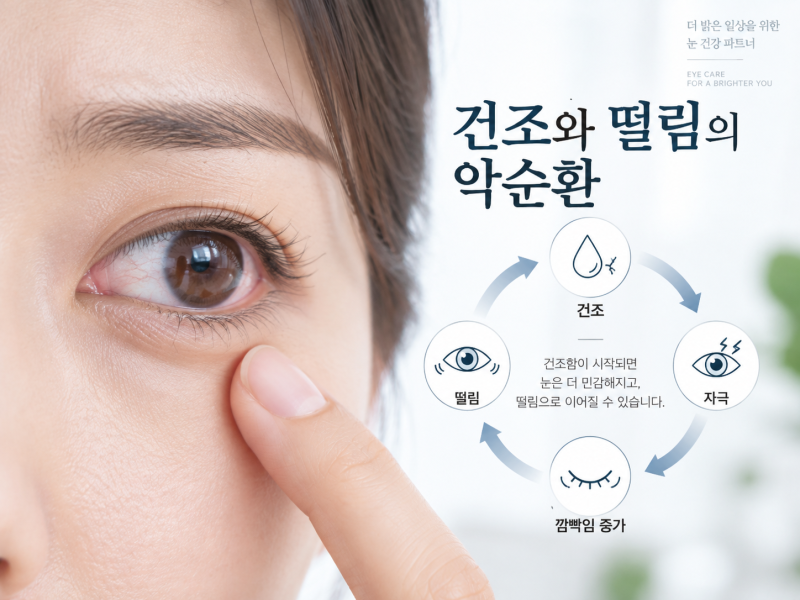
Yes. This connection is seen very frequently in clinical practice.
When the tear film becomes unstable, nerve endings on the corneal surface are continually irritated.
The body reflexively increases blinking to spread tears over the eye.
This overworks the orbicularis oculi muscle. When prolonged screen time is added on top of this, eyes become irritated, sensitive to light, and prone to twitching.
This feeds into a vicious cycle:
When staring intently at a screen, your blink rate drops, drying the ocular surface further.
The desiccated surface causes more irritation, which triggers more blinking and muscle twitching.
Consequently, many patients presenting with eyelid twitches are diagnosed with dry eye syndrome upon examination.
In such cases, the treatment is not targeting the twitch itself, but rather stabilizing the tear film.
As previously mentioned, the fact that ocular surface irritation often precedes blepharospasm also aligns with this physiological relationship.
This is also why complaints spike during autumn and seasonal transitions.
As ambient humidity drops and indoor heating begins, the tear film evaporates much faster than usual.
9. What to do at home vs. what does not work

What is worth trying (Evidence-backed)
Get more sleep. This is the single most effective measure. In the domestic study, the factors that genuinely correlated with twitching were fatigue and sleep quality.
Reduce caffeine. You don't have to quit entirely—just tally your daily cups, cut the intake in half, and observe for a week. Late afternoon coffee disrupts sleep, creating a double penalty.
Take screen breaks. Instead of aiming for an unrealistic drop in total screen hours, taking a 10-minute break looking into the distance after every 50 minutes of work is far more practical.
Cut back on alcohol. Alcohol impairs sleep architecture, indirectly worsening fatigue and twitching.
Use artificial tears if your eyes feel gritty. If dry eye is the root trigger, eye drops alone can often calm the twitch. Preservative-free single-use formulations are best for frequent use.
Apply warm compresses. This supports the function of the meibomian glands along the eyelid margin, providing substantial relief if dry eye is present.
What lacks scientific evidence
▶ Magnesium, calcium, potassium, or multivitamin supplements — As noted, domestic clinical trials showed no difference in blood mineral levels, and international medical literature classifies them as lacking objective support
(Kim J et al., 2021 / Sarkar P et al., StatPearls, 2023).
▶ Tonic water — Categorized as having no scientific proof in clinical literature.
▶ Forcefully squeezing your eyes or tapping the eyelids — This alters sensation momentarily, but does nothing to change the clinical course.
One point to emphasize:
Lacking evidence does not mean a supplement is toxic; it simply means there is no verified proof that it treats this specific symptom.
However, if you settle for simply buying a supplement, you risk missing other underlying causes that warrant medical evaluation.
10. What happens during an eye clinic examination?
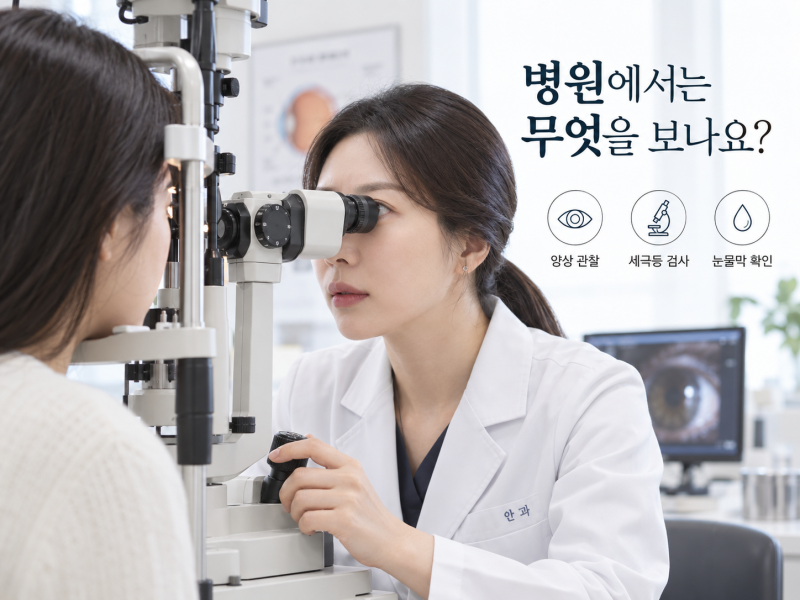
When you visit with eyelid twitching, we typically assess the following:
① Characterizing the twitch — We check whether it is one-sided or bilateral, confined to the eyelid or spreading into the face, and whether the eye actually clamps shut. This observation constitutes more than half of the diagnosis.
② Slit-lamp biomicroscopy — We magnify the eyelid margins, cornea, and conjunctiva. We check for blepharitis (eyelid inflammation), trichiasis (inward-turning eyelashes scratching the cornea), foreign bodies, and tear film status. The underlying cause of the twitch is on the ocular surface more often than you might expect.
③ Tear film assessment — We evaluate tear break-up time (TBUT) and whether tear volume is sufficient.
④ Eyelid position and levator muscle function — We evaluate whether the eyelid is drooping (ptosis) and whether eye opening/closing mechanics are normal.
⑤ Neurology/Neurosurgery referral if needed — If hemifacial spasm is suspected, a brain MRI is warranted, and appropriate interdisciplinary care is arranged.
Two tips to prepare before your visit:
▶ Record a video of the twitching on your phone. The biggest challenge with this condition is that it frequently stops right when you sit down in the exam room. A clear, 10-second video can expedite the diagnosis dramatically. Take a close-up in a well-lit space, capturing both the eye and the mouth area.
▶ Be aware of your recent sleep hours, daily cups of coffee, and current medications, as this helps narrow down the cause quickly.
11. How is it treated? Are there side effects?

① Benign eyelid myokymia — Most cases do not require medical intervention.
Addressing triggers and resting brings relief. In rare instances where twitching persists for months, botulinum toxin (Botox) injections may be considered
(Sarkar P et al., StatPearls, 2023).
② Blepharospasm & Hemifacial spasm — Botulinum toxin injection is the standard first-line treatment.
It dampens excessive contractions in the orbicularis oculi, allowing patients to keep their eyes open comfortably.
Efficacy is well documented.
Around 90% of blepharospasm patients and 80–85% of hemifacial spasm patients experience significant improvement. The effect begins within 2–3 days, peaks around days 7–10, and lasts roughly 3 to 4 months
(AAO EyeWiki, Blepharospasm / Hemifacial Spasm).
However, key facts must be understood:
First, this does not cure the underlying disease.
It temporarily reduces excessive muscle contractions; once the drug wears off, symptoms recur.
Thus, treatments are typically repeated every 3 to 4 months.
Second, there are potential side effects.
If the toxin diffuses to adjacent muscles, it can cause eyelid drooping (ptosis), incomplete eyelid closure (lagophthalmos), tearing, double vision (diplopia), or local bruising.
While these complications are usually transient, ptosis is reported in 5.9% to 20% of cases depending on the study
(Sarkar P et al., StatPearls, 2023 / AAO EyeWiki).
Furthermore, reduced blinking can exacerbate dry eye symptoms, requiring diligent ocular surface care even after injections.
③ Definitive surgery for hemifacial spasm — If vascular compression of the facial nerve is confirmed, microvascular decompression (MVD)—a neurosurgical procedure—can provide a definitive cure. Success rates are around 90%, but as brain surgery, it carries risks such as hemorrhage, facial palsy, and hearing loss
(AAO EyeWiki, Hemifacial Spasm).
Neurosurgical consultation weighs symptom severity, patient age, and overall health; it is not indicated for every patient.
④ When ocular surface disease is the cause — If dry eye syndrome or blepharitis is identified, treatment focuses there.
Preservative-free artificial tears, warm compresses, lid scrubs, and anti-inflammatory eye drops form the foundation, with specialized therapies added if meibomian gland dysfunction is present.
For patients whose trigger stems from ocular surface irritation, this regimen alone often resolves the twitching entirely.
12. Is frequent blinking in children the same thing?
Often, it is not.
When parents bring in a child for "eye twitching," close examination frequently reveals one of the following issues instead:
Blurred vision — Developing myopia (nearsightedness) or astigmatism leads children to squint or blink hard to focus. An eye exam clarifies this immediately.
Ocular surface irritation — Allergic conjunctivitis, trichiasis (inward lashes), or dry eyes are very common culprits.
Tics — If other ocular causes are ruled out, and blinking increases under tension but decreases when deeply focused, a motor tic is considered. Most childhood tics resolve over time, but ocular issues should always be ruled out first.
Order of evaluation matters.
Many parents worry about tics right away, but having an eye doctor check vision and the ocular surface should always come first. Quite often, the child simply needed a pair of corrective glasses.
For a detailed discussion on pediatric vision and myopia management, please refer to our previous post.
13. When to seek medical attention immediately

The twitching spreads beyond the eyelid to the cheek or mouth
Both eyes involuntarily clamp shut, making them difficult to open
Twitching persists continuously for more than 3 weeks
You experience eyelid drooping, double vision, or facial numbness
Twitching is accompanied by eye burning, stinging, or light sensitivity that artificial tears do not relieve
The first two signs require prompt evaluation regardless of how long they have lasted. The remaining three can often be significantly relieved once the exact underlying cause is diagnosed and treated.
14. Frequently Asked Questions
Q. Is eyelid twitching a warning sign of a stroke?
No. Fine, isolated eyelid twitching is not a typical sign of stroke.
Stroke symptoms appear suddenly and include weakness or numbness in an arm or leg, slurred speech, facial drooping, or sudden loss of vision in one eye.
If such symptoms occur, go to an emergency room immediately regardless of any eyelid twitches.
Q. Will taking magnesium really not cure it?
If your body is truly deficient in magnesium, supplementation is necessary.
However, there is no verified medical evidence linking isolated eyelid twitching to magnesium deficiency.
In a Korean clinical study, magnesium, calcium, and phosphorus levels showed no difference between 72 patients with eyelid twitching and 197 controls.
Taking a supplement will not harm you, but do not rely on it as a substitute for proper evaluation.
Q. Do I have to stop drinking coffee completely?
You don't have to quit entirely.
However, caffeine is a recognized stimulant trigger, and late afternoon coffee impairs sleep architecture. Simply halving your daily intake for a week is usually enough to see an improvement.
Q. Why is only one eye twitching?
Benign eyelid myokymia characteristically develops on one side, most often in the lower eyelid.
The unilateral nature itself is not a red flag.
What matters is whether the twitch remains confined to the eyelid or spreads downward into the cheek and mouth.
Q. Does the eye get damaged every time it twitches? Will my vision worsen?
Benign eyelid myokymia does not damage vision.
It is an isolated superficial phenomenon of the eyelid muscle, unrelated to internal ocular structures.
However, if your vision is actually obstructed because the eye clamps shut or you experience double vision, that indicates a different condition requiring an exam.
Q. Once I receive botulinum toxin injections, do I have to keep getting them forever?
For blepharospasm or hemifacial spasm, the effect lasts about 3 to 4 months, after which symptoms typically return, so repeat treatments are standard.
However, for benign eyelid myokymia, injections are rarely necessary in the first place.
Differentiating the condition comes first.
Q. What if my eyelid stops twitching once I reach the clinic?
This happens all the time.
Take a 10-second video with your smartphone whenever the twitching occurs.
Record up-close in good lighting, showing both the eye and the mouth area. A single video clip is often worth several diagnostic tests.
Q. Doctors tell me to reduce stress, but how can I control that?
That is completely understandable.
That's why, in clinical practice, we focus on measurable metrics rather than vague concepts like stress: sleep duration, coffee cups, and screen hours.
Adjusting just one of these three for a week often makes a noticeable difference.
For more detailed insights on eye health, check out the St. Mary's Jin Eye Clinic YouTube channel, 'Jineye'.
In Conclusion
Please remember these three points:
First, most eyelid twitches resolve on their own.
Managing sleep, caffeine, and screen time usually resolves the issue within days to a few weeks.
Second, there is no medical evidence that magnesium deficiency is the culprit.
Korean research showed no difference in blood levels. Do not rely on supplements alone.
Third, only two main questions need to be answered to rule out other disorders:
Are both eyes clamping shut? Is the twitch spreading across one side of the face? If either is true, the condition will not resolve on its own.
Most eyelid twitches are simply your body's way of asking for rest.
However, distinguishing fatigue-induced twitches from other neurological conditions requires magnifying the ocular surface and evaluating the exact twitching pattern.
If the twitching has lasted over 3 weeks or you notice any warning signs, please visit an eye clinic for an accurate checkup.
Feel free to reach out if you have any questions.
St. Mary's Jin Eye Clinic
337 Gangnam-daero, Seocho-gu, Seoul (1329-10 Seocho-dong)
5-minute walk from Gangnam Station Exit 5 · Free parking in building
Clinic Hours
Weekdays: 09:00 – 18:00 (Lunch: 13:00 – 14:00)
Saturdays: 09:00 – 15:00 (No lunch break)
Closed on Sundays and Public Holidays
Phone: 02-577-7782
※ This article is provided for general informational purposes and does not replace professional medical diagnosis or treatment. Quoted figures reflect findings from specific research cohorts; individual outcomes may vary depending on age, underlying conditions, and medications. All treatments carry limitations and risks of adverse events; please consult an ophthalmologist to determine appropriate diagnostic and therapeutic plans. If hemifacial spasm is suspected, interdisciplinary evaluation with neurology or neurosurgery may be required.
[References]
Kim J, Hyung SW, Han SK, Lee JY, Yu HJ, Sunwoo MK. Will Hypomagnesemia Induce Benign Eyelid Myokymia? Korean Journal of Health Promotion. 2021;21(4):129-133
Sarkar P, Mukherjee S, Chai P, et al. Eyelid Myokymia. StatPearls. StatPearls Publishing; 2023
Sanjay S, Dave T, et al. Benign Essential Blepharospasm. StatPearls. StatPearls Publishing; 2024
American Academy of Ophthalmology. EyeWiki: Eyelid Myokymia
American Academy of Ophthalmology. EyeWiki: Blepharospasm
American Academy of Ophthalmology. EyeWiki: Hemifacial Spasm
Martino D, Defazio G, Alessio G, et al. Relationship between eye symptoms and blepharospasm: a multicenter case-control study. Movement Disorders. 2005;20(12):1564-1570