2026-09-26
7th-Generation SILK SMILE Lasik Advantages vs. Conventional SMILE Lasik
Discover the 7th-generation SILK SMILE Lasik using Johnson & Johnson's ELITA laser: bi-convex lenticule, 40nJ energy, and real-time axis compensation for superior vision quality and fast recovery without dry eyes.
With summer vacation here, many people are preparing for or planning vision correction surgery.
These days, the leading vision correction surgery is undoubtedly SMILE Lasik!
However, when looking into SMILE Lasik, you encounter numerous brand names and devices, such as Smart Pro and more.
You might naturally wonder which procedure is best and delivers the highest quality visual outcomes relative to cost.
Today, St. Mary's Jin Eye Clinic introduces the latest, highest-specification SMILE Lasik procedure:
7th-Generation SILK SMILE Lasik utilizing Johnson & Johnson's ELITA system!
SILK SMILE using the ELITA platform is the most recently upgraded procedure available.
Because it utilizes the smallest spot size and lowest energy laser currently in existence, patients with high myopia can safely undergo surgery,
and it also features real-time corneal astigmatic axis compensation during the procedure!
[Key Advantages of 7th-Generation SILK SMILE Lasik]
Lowest Laser Energy Currently Available (40nJ):
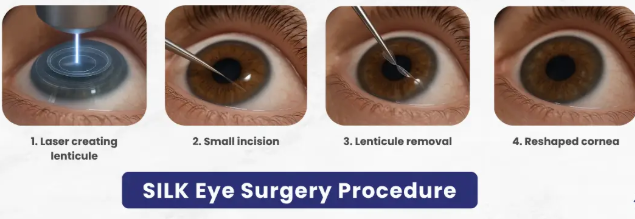
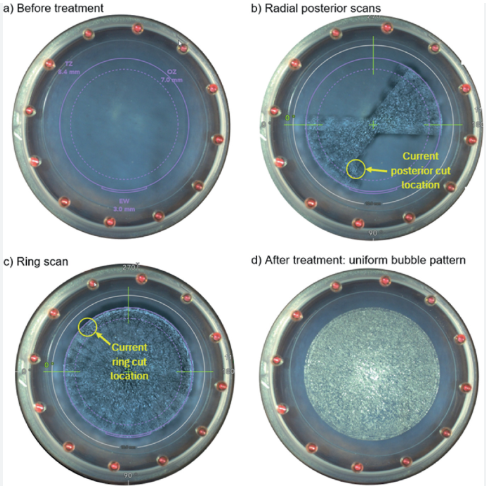
The ELITA system uses an ultra-low energy level of 40 nanojoules (nJ), dramatically lower than conventional femtosecond lasers. Lower energy minimizes thermal damage to corneal tissue and reduces opaque bubble layer (OBL) formation, leading to minimal pain and inflammatory reactions after surgery. Visual recovery is fast enough that patients can return to daily activities the very next day.
Bi-convex Lenticule Design:
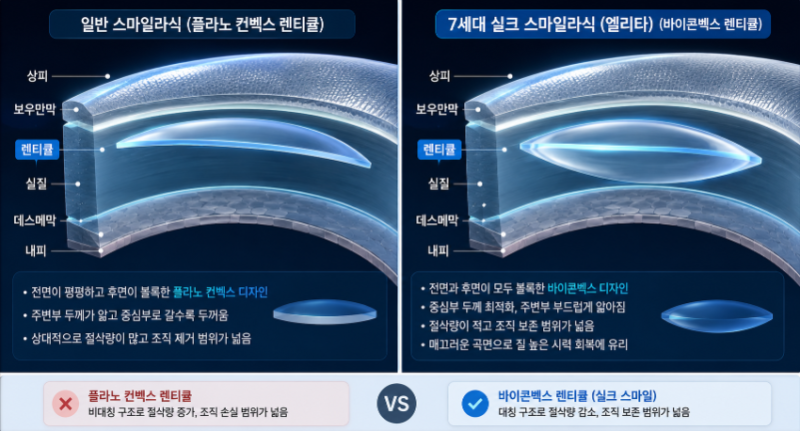
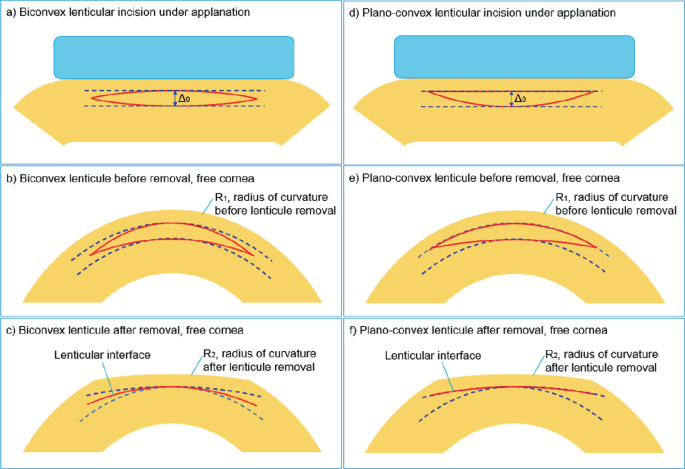
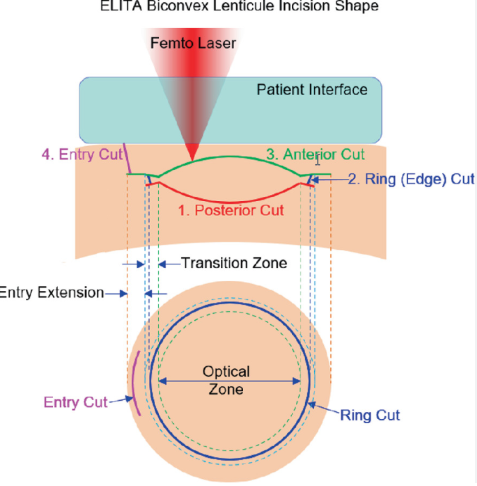
Conventional SMILE Lasik carves lenticules in an asymmetric (plano-convex) shape—flat on the top and convex on the bottom. In contrast, SILK SMILE Lasik cuts a perfectly symmetrical bi-convex lenticule with precisely calculated anterior and posterior curvature. After the lenticule is extracted, the corneal cap and stromal bed align seamlessly without dead space, significantly reducing higher-order aberrations (optical distortion) and night glare to achieve superior visual quality.
Ultra-Precise 1µm Laser Spot Size:
The laser spot size is narrowed to an ultra-fine 1 micrometer (µm) and delivered in a dense zigzag (raster) pattern. The dissected plane is smooth rather than rough—separating cleanly like true 'silk'—which reduces corneal tissue trauma during lenticule extraction.
Exceptional Dry Eye Prevention:
By creating the lenticule deep within the corneal stroma, severing of the nerve plexus concentrated near the corneal surface is minimized. Higher corneal nerve preservation effectively prevents dry eye symptoms commonly experienced post-op and lowers the rate of myopic regression associated with delayed epithelial recovery.
Real-Time Centration & Astigmatic Axis Compensation System:
Even after docking onto the patient's eye, the ELITA system can compensate for subtle cyclotorsion or decentration in real time directly on the operating table. This plays a critical role in maximizing the accuracy of astigmatism correction.
Core Mechanism of Real-Time Compensation: Cyclotorsion Detection and Tracking
In conventional SMILE Lasik, when subtle rotational drift (cyclotorsion) occurs as the patient lies down and undergoes docking (eye fixation), physically correcting it was challenging. The ELITA system technically overcomes this limitation.
Pupil Centration and Iris Pattern Recognition:
Preoperative diagnostic devices perform high-resolution mapping of the patient's iris pattern and pupil center.
Real-Time Active Eye Tracking:
Even after docking is complete and laser delivery begins, the ELITA system actively tracks microscopic ocular tremor and rotation hundreds of times per second.
Dynamic Coordinate Recalibration:
If the patient's eye rotates even by 1 to 2 degrees on the table, the system immediately recalculates laser delivery coordinates in real time and rotates the beam pattern to match the eye. In essence, the laser pattern rotates synchronously with any movement of the eye.
Why Is This Crucial for Astigmatism Correction?
The most critical error in astigmatic correction is an 'axis error.'
Physical Correlation
Astigmatism occurs when the steep and flat meridians of the cornea do not align symmetrically. An astigmatic ablation laser must concentrate energy along a specific axis to ablate the cornea asymmetrically. An axis deviation of just 1 degree significantly decreases correction efficiency, and a 5 to 10-degree misalignment can virtually eliminate the corrective effect or even induce secondary astigmatism.
[Advantages of ELITA Compensation]
Maximization of Astigmatism Correction Efficiency:
ELITA completely offsets the cyclotorsion that occurs when a patient transitions to a supine position during docking. As a result, the laser applies precisely onto the planned astigmatic axis, providing far higher predictability.
Suppression of Higher-Order Aberrations:
Inaccurate astigmatic correction inevitably induces higher-order aberrations such as coma, which is the primary cause of night glare and halos. ELITA ensures optimal visual quality even for patients with severe astigmatism through smooth, precisely aligned corneal reshaping.
Relief of Patient Anxiety:
Previously, patients worried that involuntary eye twitches caused by tension during docking might compromise surgical results; however, ELITA tracks eye movement in real time, structurally preventing potential human errors at the system level.
In summary: ELITA's real-time compensation technology closes the gap between the 'planned axis' and the 'actual treatment axis' down to virtually zero. Particularly for patients with high astigmatism or high sensitivity to optical aberrations, this compensation capability is the defining variable for surgical success and nighttime visual satisfaction.
St. Mary's Jin Eye Clinic was the first in the Gangnam area to adopt SILK SMILE Lasik, bringing extensive clinical experience as a pioneer in advanced refractive surgery.
If you are curious about state-of-the-art SMILE Lasik, feel free to visit us anytime for a comprehensive examination and consultation! ^^
https://www.joseilbo.com/news/htmls/2024/11/20241107529521.html
Frequently Asked Questions
How long is the recovery period after SILK SMILE Lasik?
Recovery is rapid, allowing most patients to resume everyday activities the next day. The ELITA platform's ultra-low 40nJ laser energy reduces corneal thermal damage and bubble formation, minimizing discomfort and inflammation.
How does the lenticule design differ from conventional SMILE Lasik?
Unlike the conventional asymmetric shape, it creates a perfectly symmetrical bi-convex lenticule. Once removed, the corneal interfaces fit seamlessly together without gap voids, dramatically reducing night glare and higher-order aberrations.
Why is SILK SMILE Lasik superior for correcting astigmatism?
It features real-time cyclotorsion tracking and astigmatic axis compensation. Even if the eye rotates slightly during docking, the laser coordinate grid recalculates instantaneously to align accurately with the target astigmatic axis.
Why does SILK SMILE Lasik cause less post-operative dry eye?
The lenticule is created deeper in the stroma, minimizing disruption to the sub-basal nerve plexus near the surface. Preserving corneal innervation effectively prevents dry eye syndrome and reduces the risk of regression.
Can patients with high myopia undergo SILK SMILE Lasik?
Yes, patients with high myopia are eligible candidates. The industry-lowest laser energy, ultra-precise 1µm spot size, and bi-convex lenticule profile significantly reduce corneal tissue stress and trauma.